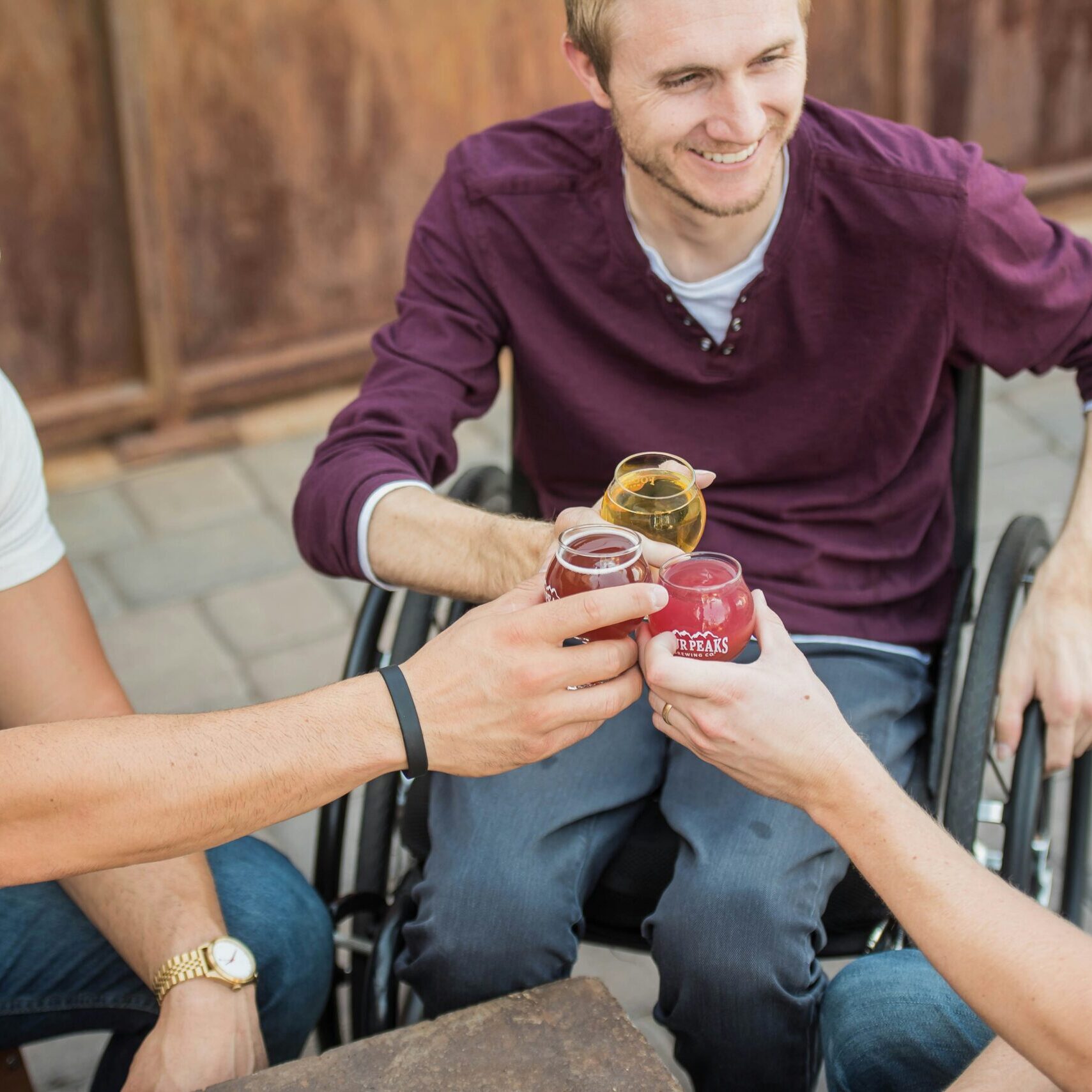
We help people who have experienced
life-changing disability
feel supported and excited again.
Disability has changed something —
your body, your capacity, your life.
The advice you've been given was written for someone in a different situation than yours.
Forget toxic self-help that makes you feel awful.
Find what actually fits the adapting Stage you are in now.
Most advice about disability assumes you're in a specific place. Most of the time, it's the wrong one.
The Disability Ownership Model™ identifies four distinct stages — not levels to graduate from, not a ranking of how well you're coping. Just four different realities, each with its own tools.
Find Your Stage
Read each description below.
Pick the one that sounds most like your head this month, not the one you want to be in.
STAGE 1 — THE OVERWHELMED SURVIVOR
"I don't want this. Why is this happening? I don't know what to do. I'm scared."
Everything changed at once. Getting through the day is the whole goal. Planning anything beyond the next 48 hours feels impossible or meaningless.
STAGE 2 — THE EXHAUSTED ADAPTER
"I'm so tired. I keep trying and nothing sticks. I figured out survival — but at what cost?"
You're functioning — barely. Good days are followed by crashes. You know what your old life looked like, and this isn't it.
STAGE 3A — THE SUSTAINER
STAGE 3A — THE SUSTAINER
"I hope things stay okay. I don't want to rock the boat. But I'm starting to wonder — is this all there is?"
The crashing has mostly stopped. You have some peace and some predictability. Curiosity is returning, carefully. If you are hoping for a next step, you might not be shure what it is.
STAGE 3B — THE REINVENTOR
"I'm ready to build something. It might be risky, but I want to try. I want to make something happen."
You have stability and you want to use it. You're thinking about projects, new directions, what comes next.
Need help to find your stage?
Answer a few quick questions so we can identify which of the 4 D.O.M. stages you are currently navigating.
I will send you a customized Starter Plan, a highly actionable guide tailored to your exact stage and capacity.
ICF-Trained Coach
Built from 200 real lives - not theory
Etienne is a person with disabilities, not an outsider
MEET OUR COACH
Hi. I'm Etienne LeSage
Hi, I'm Etienne LeSage.
My disability changed three times in forty years — and the last time, I had to rebuild my life from the ground up.
I thought I had learned how to bounce back. But that time, my usual strength wasn’t enough. When my own life was derailed, I tried to navigate it using top-down advice that completely ignored my actual reality.
I created the Disability Ownership Model because people with disabilities deserve a framework built for our specific, lived experiences.
My mission isn't to act as a guru who tells you how to live. My job is to give you the tools, honour your current capacity, and help you find the exact right lever to pull for the stage you are in right now.

What others are saying about us
I would describe Étienne’s coaching style as caring, structured, reassuring, and action-oriented. He knows how to create a safe space where I can freely express my questions, fears, and ambitions without feeling judged. His attentive listening, precise restatements, and insightful questions have allowed me to step back and better organize my thoughts. Among his key strengths, I would highlight his ability to help me discover my own answers, to respect my pace, and to transform vague thoughts into a clearer, more realistic, and concrete vision.

Samira
Recent client
Jimmy Mulzet
Etienne’s journey is a quiet yet courageous anthem of resilience. Hope, here, isn’t naive—it’s a daily act of bravery and belief in one’s worth beyond limitations. He shares truth bombs—affirming, empowering, and painfully real. Acceptance isn’t resignation; it’s revolution in the face of a world that often demands silence or shame.
Samira
I would describe Étienne’s coaching style as caring, structured, reassuring, and action-oriented. He knows how to create a safe space where I can freely express my questions, fears, and ambitions without feeling judged. His attentive listening, precise restatements, and insightful questions have allowed me to step back and better organize my thoughts. Among his key strengths, I would highlight his ability to help me discover my own answers, to respect my pace, and to transform vague thoughts into a clearer, more realistic, and concrete vision.

ETIENNE JUST APPEARED ON THE DISABILITY DIARIES PODCAST
Things can happen to me but I refuse to be reduced by them
In this episode of The Disability Diaries, Etienne sits down with Steven Vine to talk about:
- Living with cerebral palsy and refusing to be defined by it
- Three careers: programmer, minister, disability coach
- Why the disability community needs coaches, not just peer mentors
- The Disability Ownership Model (D.O.M.) and meeting people where they are
Episode: 67 | Date: September 6, 2026 | Duration: 48:34
Host: Steven Vine | Show: The Disability Diaries
(opens in new tab)
Click Here To Expand And Read The Transcript
Steven Vine: One, two, three. Hello, welcome to the Disability Diaries with Steven Vine. I am your host, and I would like to welcome everyone globally with my arms wide open to hear this special episode we have of my podcast. Whether you live in Surrey, British Columbia, or Surrey, England, or anywhere in between, my arms are open and please sit down, put your foot- feet up, enjoy the presentation that you're about to hear.
I have a very special guest for all of you today, and the special guest I have brought on is Etienne. And Etienne, could you please take a moment to introduce yourself to the listeners?
Etienne LeSage: Sure. Hi, everyone. I was looking forward to this time together. I'm really excited. My name is Etienne Lesage. I was born in Quebec, but now I live in Ontario, Canada.
I was born with cerebral palsy as a premature baby. and then along the years, I had three careers. My first one was as a computer programmer for the government of Canada. Then I became a United Church minister, and now I'm in my third career working as a disability life coach to help my fellow brothers and sisters with disability and chronic illnesses build their lives in a way that they can be excited and supported again.
Excellent ... it's a good life. Yes.
Steven Vine: We're gonna talk about your third and new career. But before we get into the, the disability coaching side of things, I was wondering if you could please tell us the quote that you have brought.
Etienne LeSage: Yes. I brought something with me that I've been carrying for a few years.
It's from Maya Angelou. She used to say, "Things can happen to me, but I refuse to be reduced by them." Who said that? Maya Angelou. Oh, excellent. What does this mean to you? It means that life happens, and we can never fully know what's gonna come our way. But even when things are hard, there is always a way to pivot so that we can turn painful moments into new reasons for meaning a- and to rise again and to be happy again.
Steven Vine: Excellent.
Etienne LeSage: I'm thinking that there is a lot of challenges that I had to go through in my life that actually allowed me to find things in myself That allowed me to be, to become the person I am, and you don't want to erase those moments anymore. Even though they were painful, you know that you managed to turn them into something good for you and for other people.
Steven Vine: We do all have to persevere in our own way, don't we?
Etienne LeSage: Yes. We always have the choice, but if we decide not to, then then we're sure that things are not gonna work as well as they could be for us. I- it's either we have to jump into uncertainty a- and find the right resources to help ourselves or decide to give up, and then there's no uncertainty, but we're just certain that we're not gonna live up to our full potential and that's just sad.
Steven Vine: This is gonna be a very interesting conversation, I can tell just by your quote today and what it means to you. Thank you for taking the time to explain that. Before we get into the conversation how about you, Etienne, let us all know about the journey that you have taken to get to this point in your life.
Tell us-
Etienne LeSage: Wow ...
Steven Vine: tell us in, briefly, the, the points that you'd like to share with all of us about the growth in the areas that you've gone through.
Etienne LeSage: There, there are so many things. Our lives are filled with so many stories.
Steven Vine: Yes.
Etienne LeSage: For me I started as a... My parents told me that I was always a very joyful baby.
Okay. And I didn't think there was anything different with me until I started school, and this is when I had to interact with other kids that they actually made me understand that, oops I'm different. And it's only later, maybe around eight years old, that I was blunt with doctors and say, "Hey, listen, when is it that you're going to cure me?
When is it that you're gonna hear me? 'Cause heal me," 'cause at the time my problems were just with mobility. A- and they said Etienne, you have cerebral palsy and this is not something that's curable. It doesn't get better. It doesn't get worse. You'll be like that all your life." And this is when my heart broke in two.
And I realized, oh boy, it's gonna be, it's gonna be a tough life. And it's hard for a kid to come to terms with I will not have an easy life.
Steven Vine: Of course.
Etienne LeSage: And, a- and it's only later that I've realized, I've I've learned where my talents are. I couldn't play sports, but s- a, an aunt gave me a piano in in her will, and playing music became my sport.
Steven Vine: I see.
Etienne LeSage: And so I've learned piano, and I played until, until I had to stop because my fine dexterity was, like, was limiting me there. And my parents advised me to have to find a career where I could sit down, which is why I started with computer science. But then I figured out that my greatest strength, even though I was having a promising career, was with connecting with people.
That's what I do best. And I felt my call to ministry come, to come back, and it was very scary, but I took a leave of absence from the government for five years to go back to seminary a- and study, and they gave me my leave thinking that, "Oh, there's no way. He's not gonna come back." But I found it was my place, and and then I became a minister and things were really going great until I realized that, oh, boy, working in those old churches, this...
th- these are not the most accessible places.
And and my physical abilities were changing because I've realized no one had prepared me to the fact that when you live all your life with a disability, you feel the effects of aging differently. So things started to pile on me, and then I got my grandma's arthritis, and all the...
and my brittle bones from my aunt. It's like I won the lottery to, to have all the physical conditions pile up. So that means that I have both experience of having been disabled all my life, but I have experience, too, in having unexpected changes in, i- in your disability that completely overwhelms you.
And what I deplore in society is it seems that services for people with disability, they're mainly medical, trying to fix you when they can, or trying to put you on government programs to, toss up in a corn- to- toss you in a corner of your house to put you in legislative poverty.
And we need more than that. People with disabilities are still people with tons of gifts. Challenges, yes, limits that need to be respected, but gifts. We all need to contribute to society. So there's... I couldn't find... The last time I lost my, my, my career, I couldn't find any help for emotional, social stuff or finance stuff, or even how do I reinvent myself?
So you mean- And I- sorry to interrupt you. Do you mean support from others? Yes, and also ideas on what to do with myself. I see. Okay. I thought I had very good resilience reflexes, but this time the change was so abrupt-
...
Etienne LeSage: That e- even my own courage and my own resourcefulness was not enough, and I couldn't find anybody to...
who would understand what it is, what is it to walk a m- a, a mile in my shoes- ... or to spend time in my wheelchair. A- and so that's why I became the coach I always wanted to have.
Steven Vine: So was this thought out about going into a coaching career, or did you do this suddenly?
Was it something that weighed on your mind for a while before you made the change?
Etienne LeSage: I was as, as it happens for many people who became, who become disabled, I was overwhelmed to a point where my mind was not even able to generate good ideas. Sometimes our mind it's our mind's job to keep us safe, and when you become disabled- To protect ourselves.
Absolutely. Yes. Okay. But sometimes w- it gets so hooked on protecting ourselves that it's unable to generate creative ideas.
Steven Vine: Yes.
Etienne LeSage: So y- we have to treat ourselves with a lot of kindness to be able to do that. For, so for me, it took a few years for me to be able to go back to finding a baseline where I could, "Okay, I can survive now, and now I can reali- oh, I can still express some of those talents and do this and that."
And then my mind opened to being more creative. First, I was trained to be a peer mentor, but you're not supposed to... But I realized that what I wanted to do was to coach because there are things that you're not supposed to share as a peer mentor, but as a coach you can. So it took a few years for, for me to end up there, but I'm sure that if I had a coach I would have saved time on those five years that, that were excruciating for me.
Yeah. How long have
Steven Vine: you been coaching the disabled now?
Etienne LeSage: This is I, I would say gradually. It's like now I've been doing this as a a, a permanent thing since about a year, but I was doing it informally here and there. Sometimes as a volunteer, but it's it's been a year that I really...
All I do is to coach people individually or in groups and that I do it, 'cause I'm trained to coach any kind of issue, any kind of person but in my own, in this new specialty for my fellow brothers and sisters with chronic conditions this is about a year.
Steven Vine: Okay. Excellent. And tell us about your disability before we get into the coaching on how much this affects you on a daily basis.
You already brought up the fact you're in a wheelchair, correct?
Etienne LeSage: I am, I I, I am in a wheelchair when I go out, yes.
Steven Vine: Oh, when you go out, okay.
Etienne LeSage: When I go out, I use a wheelchair. Okay. When I am inside, I use a walker.
Steven Vine: Okay.
Etienne LeSage: And I used to walk then I s- then I started have, to have to need a cane-
Steven Vine: Okay
Etienne LeSage: when I was about 20, and then I started needing a, a, a walker when I realized, oh boy, it's getting too stressful to cross the street. I'm always afraid I'm always freezing and afraid that I'm gonna get hit.
Steven Vine: Yeah.
Etienne LeSage: So it's time to get a walker. And I was even considering getting a wheelchair permanently, but my doctors were not too keen on that.
S- it's important that we kept moving when we can because we can decondition very fast. Yes. And they said, "If you, if I sit you in a wheelchair permanently, you'll spend half of the day in the gym not to lose what you have." There's always a give and take like this. And another thing that happened to me like a year and a half ago, my puppy jumped on me when I didn't expect it, and I fell and I broke my hip.
Steven Vine: Aw.
Etienne LeSage: And I stayed in, instead of replacing my hip they fixed it with screws which forced me to be immobile in a hospital bed for two months, and it's quite amazing how fast our muscles melt, they can melt down when we're not moving. That's a real disservice, and I'm still trying to get back to my baseline as to how I was before the hospitalization.
Bec- it's a lot of work, but I'm getting there. I even have some hope that I might be able to make a few steps with a cane at my wedding in July.
But I am not psyching myself too much about it, because if it doesn't work, I still want to enjoy the wedding and bask in their joy and not feeling like I'm failing.
Steven Vine: You come across, Etienne when we talked before today and now that we're talking on the recording you come across as a very positive individual. Where do you get that from? Where do you get that you look at something and you obviously wanna communicate, you're a good communicator, and you're doing it in such a positive way.
Where does that come from?
Etienne LeSage: I think it comes from knowing what gives me energy. We all have things... when we have disabilities, we don't have the luxury like non-disabled people to just spend our energy on everything. We have to choose and we have to know what is costing us too much, but also what is giving us energy, and we forget that.
And for me, what is really giving me energy, because I'm super extroverted, is connection with people. So I have you on the phone and you're there with Chris recording this, and I'm just excited that I get to talk with people, and I know that there's people at home that are also listening in. I wish I could, I wish I could see them right now and connect 'cause I'm really good at this.
Yes.
Steven Vine: Yes.
Etienne LeSage: So I'm positive, I would say, not because there... I guess I'm not Superman. I've always been very joyful 'cause it's one of my core values. My core values are joy, compassion, and growth. So any time I get to express those values, I know it's gonna give me energy. Because when we're true to who we are, energy stays with us instead of just like running down it...
and being wasted.
Steven Vine: Yes.
Etienne LeSage: So I guess my answer is I'm positive now because I'm being attentive with you, true to my values, and you can always find a way to be true to your values regardless of the disability you have. Yeah. So I always encourage people to really be aware of what is it that gives you energy, and sometimes we have to think it through, but once you discover it, you do more of it and this is what happens.
You have more energy for yourself, and it flows between you and other people.
Steven Vine: Now, does your cerebral palsy, For you, dealing with the cards that you have been dealt, is it a test on you on a daily basis of getting through the day with this?
Etienne LeSage: It depends. The, the days are unexpected and because also in the last five years that I was confused I had so much challenges physically and mentally that I also developed depression.
Steven Vine: Okay.
Etienne LeSage: So s- so I'm a joyful person but I'm fully aware of mental illnesses issues. A- and I found a way to notice when is it that oh the, the, the, there's a veil that is about to come. Okay, let's, let's- Yeah ... let's reorient myself. Yeah. So not all the days are the same. I have days that I have more energy.
I have painful days. Right now I don't know what it's like in, in BC, but here in Ontario, it's like winter and spring cannot stop duking it out and it's really rough on the joints and and there's a lot of people grunting because of this dampness. So of course, this is difficult and you, sometimes I long for days where I was able to do more but I try to stay with what I can give this day or this week and I try to use my own advice.
Yeah. And, You listen to
Steven Vine: yourself.
Etienne LeSage: I, yes. Yes. I don't want to be one of those guys who say "Do what I say, not what I do."
Steven Vine: Okay. Great. If I was interested in connecting with you for coaching, what would I need to have to qualify for you to get involved?
Etienne LeSage: So I would say- is there,
Steven Vine: is there requirements is, I guess is what I'm asking.
Etienne LeSage: No, I can work with, I can work with everybody and I I haven't found any kind of disabilities for which there was not a hope to regain some control and some excitement about your life.
Steven Vine: Yes.
Etienne LeSage: I think ev- everyone there's room for everyone. I think what it, what would be useful for people to know is now I have enough experience to kinda lump three kinds of stage of disability.
And this is my own framework, what I've observed. So it's always good to know in which stage you are. Maybe I can tell you a bit about those. There's the first stage where you either have a new disability or your disability change and you're overwhelmed and you're like, wow.
Y- your life changes drastically and you're grasping for air. And in this time, what you need is just a bit of hope a- and ways to know- y- w- what are the primary needs you need to fulfill and how? And so when you're in that stage I'm not gonna start talking to you about accepting a disability, for instance because it's just too overwhelming right now.
So we're talking more about grief, about what we can do, what kind of support we can w- we can start putting in place, and resources. Then there's the second phase where, okay, you're used to, used to your disability. You're surviving. You're not thriving, but now you're starting to be open to different ways of looking at your disability.
So then this is when I start talking about acceptance, or, "Have you thought about this?" Or, "Have you seen this strength?" And, "How about this?" And we're opening our mind. Nice. And then there's the third phase where we're s- we're, we have the energy to say, "Okay, now I want to change something in my life.
I need help. Let's go. I'm ready for work. Let's work." That's the third stage, and those people are really ready for one-on-one coaching. But maybe those who are earlier, like in the first stage the it's it's too early to start to start doing one-on-one. But I try to have resources online for people at every stage, and it's not just a straight line i- because you can spend some time in, in, in stage two in your life and then three, and then whoops, I broke my hip.
I'm back in stage one. And, oh, no now all my plans are delayed for another year and a half. Or then you can go from two to three again. You, it moves. So I think it's important- Not to take on more than you can chew, but at every stage of disability there is room for more hope, for more support, and for good things.
So- And I don't want that to deter anybody from contacting me.
Steven Vine: So a lot of the disability aspects of one's life is mental. It's psychological on how they are looking at what's disabling them, whether that's a neurological situation, whether it's a physical situation, whether it's a developmental issue.
It's derived mostly through the brain and how one looks at life. Is that correct?
Etienne LeSage: Y- partly. Yeah. I think we can... There's things that that we can improve by changing the way we look at ourselves and our condition. Our perspective? Yes. But there is also the fact some of the challenges with disabilities are caused by factors external to us too.
Like some would argue that it's society that creates disabilities when they create all sorts of barriers for different kind of people. Yeah. And so i- without those barriers, we wouldn't have the disadvantage of disability. So I think it's a bit of both. We need to advocate for what we need in a society and we, I think we also need to personally give ourselves a chance to, to seeing ourselves in the best Truest, if that's a word in English, more authentic light so that we feel that there's more options for us ahead of us.
'Cause nobody is doomed because of a disability. It's not easy, but... And y- 'cause, a- and th- there's another thing that I am trying to teach to people about this, is that disability shouldn't be something that we avoid as much as we do these days, as if there's non-disabled people and disabled people, like us and them.
When we're in this kind of mentality it's how people, the m- non-disabled majority will sometimes feel irritated that- ... that we're asking for more access and things. But what I'm teaching people is that being disabled is not abnormal. Being disabled is the normal course of life.
Steven Vine: Yeah.
Etienne LeSage: Because if we are blessed to live long enough y- you and I will have an experience of disability after birth, after a disease, after an accident, or just natural aging. It's going to happen. The question is, when it happens, are we ready to still, to s- to still be there for people with disabilities and for, to show up for ourselves, or do we feel off, do we fall off the face of the earth?
Steven Vine: It
Etienne LeSage: sound- And, but-
Steven Vine: Go ahead.
Etienne LeSage: Yeah.
Steven Vine: Go ahead.
Etienne LeSage: No, go ahead.
Steven Vine: I was gonna say, it sounds like you get an awful lot of fulfillment helping coach a disabled individual. Is that correct?
Etienne LeSage: Yes, because every time I see hope and possibilities for someone else with a disability, it reminds me that the same is true for me.
We need to remind each other of that because no one is always fully empowered. We have good times and rougher times. Yes. And the, the more the merrier. My dream is that... I don't think I'm gonna see this in my lifetime, but my dream is that people would say, "Oh, okay. When I'm disabled, I'm ready.
I've prepared," or, "Society will be ready for me," and that's fine. That's fine. So we have this, all this extra pressure on our shoulder that's relieved. But I think it's a, a, a bit of a pipe dream. But we can still improve and it's a matter of doing your personal share to help yourself, but also helping society to be ready for that human reality as well.
Steven Vine: You just used the word helping. Now, I wanted to point out that's what you are doing. You're helping others. And with you being a helper and being a Canadian citizen living in this great nation of ours, do you feel that in this society the disabled are getting enough help?
Etienne LeSage: No. I, I don't think so because people don't identify with disabled people.
But if you really think about it that it's coming your way you're like... It would give an incentive to society to to be more mindful of what is it to move in society, what is it to work in society, what is it to be in relationship wh- whe- when you have a disability.
And if people remo- remind, reminded themselves that, "Oh, it could be me. It will be me one day," then suddenly you're not just doing someone else charity, you're actually advocating for yourself. So I think if people knew how much u- disability is a universal prob- not problem. It, disability, it's not a problem, it's a normal stage of life.
It if, but if people understood how universal it is, then there would be more help because people would want the help for themselves too, yeah. So sometimes we need to present things in a way that really sounds like a win-win. Not inven- not inventing things that are not true but I think this is a truth that needs to be understood all over the world.
And this... and people with disabilities they, i- if we're just given a chance to be able to express that in various ways I think it would be helpful for everyone. We're the great- the biggest majori- the biggest minority in the world. Everywhere at any time, 15% of the population has a disability or a chronic condition.
It is a universal problem and it is not seen as such, sadly.
Steven Vine: You're... You got that right, brother. There's there's not enough people that are accepting in the disabled way of life, and that a lot of people don't realize that they probably are going to eventually be dealing with a disability in their own life.
And g- on that note with, everyone eventually gets some sort of disability, do you find there's any sort of common threads with people's outlook that are dealing with a disability? For example, do you think anger is a characteristic a lot of disabled people have?
Etienne LeSage: It depends where you are in your life yes I think it's a r- anger is a really normal way of dealing with grief. Yes When we lose anything, sometimes we lose something, we lose a job, or we lose a body part, or we lose some function Yeah A- anger is normal, You get a little pissed off, don't you? Absolutely. For me, it was when I was eight years old.
I
was, w-
eight years old and I needed to be pissed off at someone. It's like, "What do you mean I'm gonna be disabled all my life?" For sure and I was raising my fist at God "Why me? Why me?" Yes And of course- Of course ... it takes a while to, to process these things, and of course, a- and I had to deal a lot of, with that work to become a healthy minister because, just 'cause I needed to be able to find a meaning and an answer to these questions- Yeah
Just to be, like, spiritually authentic. Yeah and I think that it's, it never feels fair when disability enters your life or when it gets it gets worse. Like me, I have a head start on, on, on some people and i-i- there's... the question so much that is important is not why me?
It's more like, okay Ah, this is my reality. How do I make the best of this? And it's okay to feel that. It's not... if some people are listening right now and they're thinking, I'm not ready to accept my disability. This isn't fair," that's fine. So if you find that, if you find right now that it's hard for you to get past the that's not fair phase, then you can ask yourself what can I do to treat myself fairly?"
At least you can do that. At least you can not beat yourself with a stick. At least y- you can treat yourself kindly and listen to your body and observe. Observe what helps you and what's not helping you and look for help. You can do that. And reactions of it's not fair, I don't know why I was disabled from birth and that another person may be after a disease when they're 50 or 60 or 70, I don't know.
And I don't think I'll ever get an answer to that question until it's my time to meet my maker. But I think that we have to remember that even when we have a disability that we don't want, we're still human. We're still we're still whole. We- Th- they might have taken a leg away, but they n- they haven't taken anything away for you from you as a person in that you can still shine as a human being in your own way.
It's just a matter of finding the right allies and the right help, and I believe we can be contagious. And Steven, you're doing that with this show. I've learned about your show a year ago. I've been following you for a year ago. I never thought that one day I'd be one of your guests.
Steven Vine: Yeah.
Etienne LeSage: But you're actually spreading this contagion, this story that says no.
I know it's hard, but there is a way for you to have a good life with disability. And you're not alone. There's a whole bunch of us-
Steven Vine: Yes ...
Etienne LeSage: who cares- That's right ... really deeply. And yeah, that, that was a long answer to your question about anger, but I don't want your audience to feel guilty if they're angry.
That's okay. You won't be angry for the rest of your life, I'm telling you. Just give yourself a chance, and we'll take you the way you are, and we'll help you anyway. The world is there to help you even if sometimes it feels hostile.
Steven Vine: You've been doing this for a year now. Have you learned a lot in the last year as far as disabilities go and how you are personally helping others?
Have you learned a lot from the people that you've dealt with and met?
Etienne LeSage: Yes. Yes. And I've learned how beautiful we can still be when we're not trying to be superheroes.
Steven Vine: Yes.
Etienne LeSage: That's the main thing. It's sometimes it feels like society gives us two narratives for people with disabilities. You're either the poor, pitiful, disabled person or the superman, superwoman who inspires everyone and victorious about everything.
And but either, either situations, extremes are not good on us. Yes. They put a weight on us that it's really bad. I'm learning as I'm coaching that the most beautiful place is to be in between-
Steven Vine: Yes ...
Etienne LeSage: where there's room for us to be human. I had to learn a lot about mental illness. I always thought that, being this strong, disabled person who achieves things a- and overcomes challenges, I never thought that I would ever have issues of mental health.
But no, no one is infallible, and pretending that we can function exactly as well as someone who has no disability takes such a toll on us, we end up cracking at some point. And I didn't crack because I was weak. I cracked because I was human. So now, because I've survived a big episode of of depression, I know even more about the beauty of people and about the strength that we can always find, even when it feels so dark that you think that the only way out of your disability is death.
It is not.
Steven Vine: That's
Etienne LeSage: inter- I've learned that.
Steven Vine: That's interesting-
Etienne LeSage: Yeah ...
Steven Vine: that you brought death up with disabilities. And the reason why I say that is the MAID program, Medical Aid in Dying, is now 6% of all the deaths in Canada, people going through that program of saying, "Please, let's end my life now. It's not worth living."
And a lot of those people that are doing that are disabled individuals that are living a life where financially the government is not even paying us anything close to poverty. And we're supposed to- Yeah ... get through life with our disability and the standards so low below poverty Do you think there's anything we can do as a nation to try to change these numbers in MAID so that not so many disabled individuals are saying, "My life is not worth living"?
And I know that's a heavy duty question, but, you've been around different individuals with disabilities, and perhaps you've learned over the years that maybe we all could get some help in some areas so that less people are looking at MAID to fix their lives.
Etienne LeSage: Yes. First of all I want to say that I am not judging.
As a minister, I had people who were afraid of what I would think when they announced that they would go for MAID, and I didn't judge them. They actually died in my arms, and I would understand when they were in a physical condition that was so painful and unbearable, and I've accompanied them, and I've honored them, and that's okay.
I am not judging people who decide that MAID is an option for them. But I don't want MAID to be used as a, a thing by default because as a society We're not good enough at helping people who want to help themselves but don't find options.
So I think that it is a very dangerous road because then i- if the way things are going, if people with disabilities do that because they think they're out of resources and life is too miserable without being in, in excruciating pain or having a, a, a very limited lifespan left- Yes
th- then it may becomes euthanasia as opposed to to help to el- alleviate suffering. So what I think is important to do is to, one, ask our government to fund initiatives to help people with disabilities, and even why not coaching? That would be... That, that would be very good because- Yes
it's the kind of help that always looks at the present and looks forward. And even from a very purely financial way for the state, it... Healthier people cost less to society anyway. Yes. So that's, that would be an incentive to convince them. But we also have a duty to talk about suicide prevention and say, "Hey if you're ev- if you even feel like now, death is an option to get out of your pain, then you're not broken.
It's just a sign that you really need help. Get it." Yes. Get the help. We need to talk about this, this message a- and to not be ashamed about it. No. I had times in my life where I considered I considered that maybe dying would be a best solution. I'm glad I didn't go there.
So am I. But, but it... I think it happens to... it, it- A lot of us ... happens to everyone.
Steven Vine: Yeah.
Etienne LeSage: Yeah. Yeah.
Steven Vine: Before we wrap things up, Etienne do you have a message for the listeners at all that you'd like to say that you haven't said yet in our talk?
Etienne LeSage: I want to say that every, every challenge has a flip side that is a promising strength I want to say that every superpower that we have li- as a person with disabilities, 'cause we do have superpowers that non-disabled people don't use as much, like empathy, like awareness, like our ability to plan, our ability to prioritize 'cause we can't do everything, our thinking outside the box, our resilience, our courage.
I... But I think that also has a flip side. So every challenge has a big strength, and if we don't watch our strengths, sometimes they can turn back into challenges. It's just a matter of giving ourselves the chance to look at it and discover more about ourselves in the process. I want to encourage everyone to help themselves that way.
If you are interested in knowing more about my coaching, my website is risingdisabled.com, and I've also started a community on Skool for us to... I call this the disability hive mind, where we all come together and we look at issues, and we all use our experience to help each other. And I add masterclasses there, and I have even some, some scripts to help you when you want to collaborate with your doctor, when you want to ask something to your employer, when you want dating to be more pleasant, all sorts of things like that.
If you wanna join that free community, you can also go on risingdisabled.com/join. And I'll be happy to chat with you in, either by email or in that community and see what we can do together. I'd be happy to help you, but I would also be super happy if you help me help other people- Yes ... 'cause that's the way it works.
Steven Vine: Now, are you able to communicate and coach an individual long distance?
Etienne LeSage: I do all my, most of my coaching online. Okay. So I'm very comfortable doing it. The best is online with a video camera, like on Zoom.
Steven Vine: Yes.
Etienne LeSage: If not, it's doable it's doable on the phone, but it's better when we can see each other.
The connection is stronger. Of co- of
Steven Vine: course, yeah. But the option is still there.
Etienne LeSage: Absolutely.
Steven Vine: Well-
Etienne LeSage: I'm flexible. Yeah.
Steven Vine: I would like to thank you for today, Etienne. You have been very informative about your services and your philosophy about helping the disabled. You're a real helper. It's important we have individuals like yourself that are keeping the momentum going in a positive direction.
And I wish you all the best with your coaching, and I hope that our paths someday cross again.
Etienne LeSage: It's a it's a privilege. Invite me again if your, y- if your audience is curious about things. Yes. Thank you as well to you, and I want every brother and sister with a disability or a chronic illness out there to know that I believe in you, and that y- you deserve to believe in yourself, too.
Steven Vine: Thank you.
Chris Denarde: Okay, so that's another great example, Steve, of a guy who saw a need and worked on it. Like he saw the need that, disabled people need to talk to someone. Maybe they're young, maybe they don't know what to do next, maybe they gotta go through different stages. So he saw a need and he started to fill it by starting this counseling services.
Steven Vine: Yeah, he realizes that people need help, and people will ask for help, and the listener, that's what you need to do. If you're not getting the help, ask for it. It's, there's nothing wrong with asking for help when you are going through a challenging time with disabilities. And, I really like Etienne.
He's such a positive man, and I really wish I could have interviewed this gentleman longer than what I did today. But we made the best of what we could do as far as time goes, and, maybe there's gonna be time in the future that we can check in on him and see how he's doing with his coaching in the future.
Chris Denarde: Yeah, absolutely.
Steven Vine: Okay, Chris. Absolutely. Thank you.
Chris Denarde: Okay. Thanks, Steve. Bye.
Steven Vine: Bye.

PURSUE YOUR DREAMS WITH JOY AGAIN
Start Private Coaching with Etienne
Disability doesn't have to stop you; it can bring you forward! Are you ready to unlock your true potential? Our program offers a transformative opportunity to help you break free from what might hold you back. Set meaningful personal goals, and craft a personalized action plan that fosters resilience and adaptability. This journey towards empowerment will enable you to pursue your passions with purpose and excitement.

Download our free guide
Transform your disability into a friend
Embracing disability is challenging, but it is a necessary step to living your best life. This 10-page PDF guide shares steps to make this process easier for you.
Join our free community on skool
Forward With Disability
Rebuild your life WITH disability. Sharing mutual strategies, peer support, no toxic positivity. For people ready to rise strong, it's easier together!